Learning Through Discovery
Research in Action
Students investigate authentic NASA observations, analyze exoplanet light curves, and develop computational thinking by exploring how astronomers search for planets beyond our solar system.
Powered by NASA Public Data
Explore NASA Data
Students investigate real observations from NASA missions such as Kepler and TESS to understand how astronomers search for planets orbiting distant stars.
Analyze with Python
Using Python and data analysis techniques, students identify patterns, investigate planetary transits, and explore how computational tools support modern astrophysics.
How Students Investigate Exoplanets
- Collect NASA Data
- Clean & Prepare Data
- Analyze Light Curves
- Detect Transit Signals
- Investigate Planet Candidates
Current Research Investigations
Nancy Grace Roman Space Telescope
Developing a predictive simulation pipeline to quantify the atmospheric characterization potential of the Roman CGI and WFI.
- Bayesian Retrieval
- Roman CGI Sim
- Nested Sampling
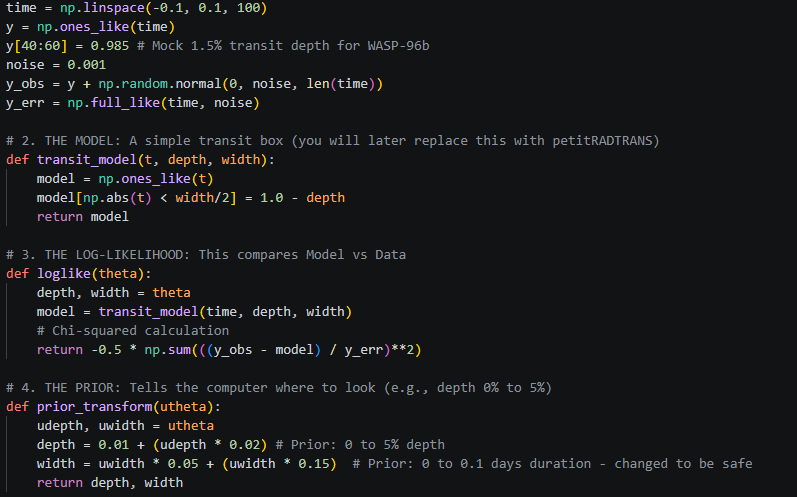
Cross-Mission Validation: WASP-96b
Benchmarking TESS photometry against JWST NIRISS spectra to resolve the abundance-cloud degeneracy in Hot Jupiters.
- petitRADTRANS
- lightkurve
- JWST NIRISS
Large-Scale Data Engineering
Collaborating on automated light-curve processing and pipeline optimization during a professional research residency.
- Data Pipelines
- Automated QA
- Python Engineering
Augmented Detection & Flux Analysis
Extending baseline CNN models with synthetic data augmentation to improve exoplanet detection in low SNR environments.
- TensorFlow
- Data Augmentation
- CNN Architectures